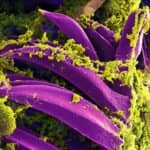
A study of Streptomyces bacteria reveals a coordinated attack on bacterial biotin production, offering a new strategy against multidrug-resistant infections.
RT’s Three Key Takeaways:
- Antibiotic Megacluster Discovery: Researchers identified a rare cluster of genes in Streptomyces bacteria that produces four distinct families of antibiotics working together to target a single bacterial vulnerability.
- Biotin Targeting Mechanism: The newly characterized compounds disrupt the production and use of biotin, an essential nutrient for bacterial survival, which may make it more difficult for bacteria to develop resistance.
- Therapeutic Potential: Early testing in animal models showed that two of the compounds were effective against multidrug-resistant Escherichia coli (E coli), suggesting a possible new clinical pathway for treating resistant infections.
Researchers at McMaster University discovered a “megacluster” of genes in Streptomyces bacteria that produces four antibiotics working together to stop rival bacteria, according to a study published in Nature. The study describes an unusual stretch of DNA encoding four distinct families of natural product antibiotics, including one compound new to science and another not previously recognized as an antibiotic.
Together, the four molecules target a single vulnerability: biotin. Also called vitamin B7, biotin is an essential nutrient required by most bacteria for survival, growth, and cell division. The newly characterized antibiotics disrupt biotin production, uptake, and use, providing a model for how antibiotics can work together to fight drug-resistant infections.
“It’s an all-out, strategic, and coordinated attack on rival bacteria,” said Eric Brown, a professor of biochemistry and biomedical sciences at McMaster and principal investigator, in a news release. Brown likened the approach to a siege where different molecules take out power, communications, water, and roadways.
The researchers found that the co-location of these four antibiotic-making gene clusters is rare. The clusters are also flanked by two streptavidin genes, which allow the bacteria to manufacture proteins that bind biotin.
“The proteins are made to bind up available biotin, while their neighboring antibiotics prevent competing cells from getting to it first,” said Brown.
The study found that this anti-biotin antibiotic megacluster is widespread across different species of Streptomyces, suggesting the strategy has been conserved over millions of years.
“Our analysis showed that this megacluster is even more widespread across Streptomyces genomes than the genes responsible for making streptomycin,” said Rodion Gordzevich, a postdoctoral fellow in Brown’s lab, in a news release.
The team tested the compounds in animal models of infection and found that two were effective against multidrug-resistant E coli. Brown noted that a coordinated strategy could make it harder for resistance to develop because bacteria would likely have to evolve several distinct resistance mechanisms.
The researchers suggested that nutrient-targeting molecules represent a large reservoir of potential antibiotics that have been overlooked. Traditional laboratory methods for determining antibiotic susceptibility often use media rich in vitamins and nutrients, which can mask the activity of molecules that target nutrient acquisition.
“What this work tells us is that there is an entire world of nutrient-targeting molecules just waiting to be discovered,” said Brown in a news release.