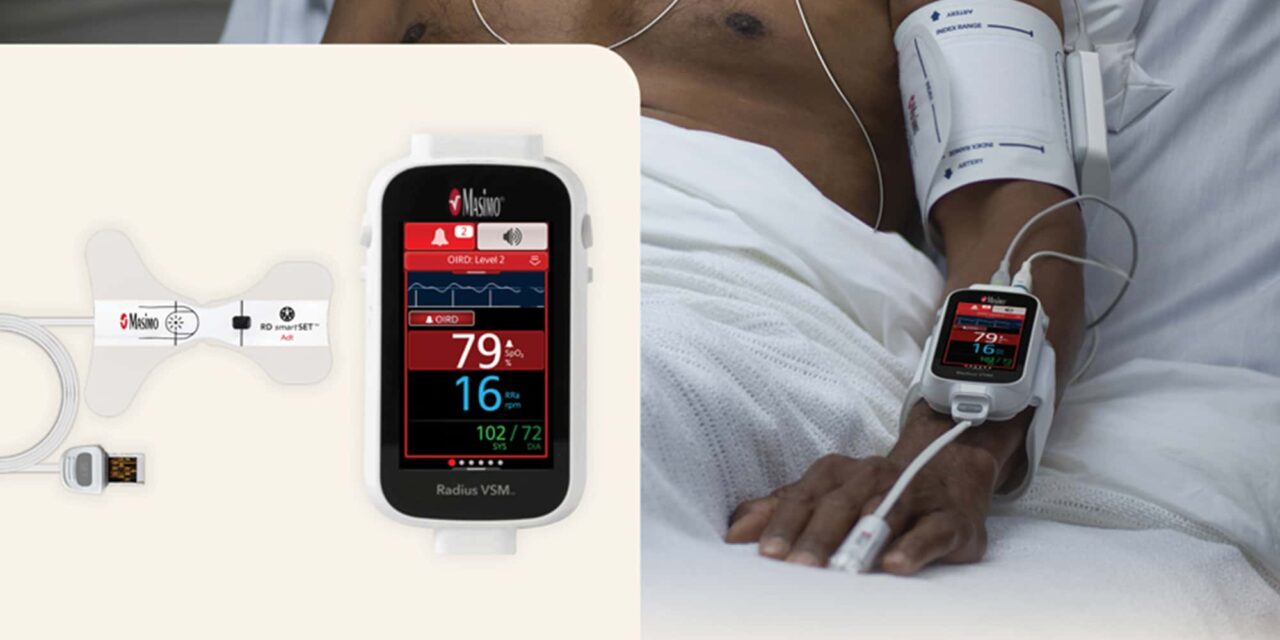
The new capability for the Radius VSM wearable monitor uses pattern recognition to help clinicians identify early signs of opioid-induced respiratory depression (OIRD).
RT’s Three Key Takeaways:
- FDA Clearance: Masimo received FDA 510(k) clearance for an Ai-enabled feature that detects opioid-induced respiratory depression on its Radius VSM wearable monitor.
- Pattern Recognition: The technology analyzes continuous physiological data to identify early signs of respiratory compromise in hospital patients receiving opioid therapy.
- Clinical Alerts: The system uses visual alarms that escalate as risk increases and can be relayed to remote or centralized monitoring stations.
Masimo received USFDA 510(k) clearance for an opioid-induced respiratory depression (OIRD) detection capability for its Radius VSM wearable continuous patient monitor, according to the company.
The new feature uses pattern recognition to analyze continuous physiological data. This allows clinicians to identify early signs of respiratory compromise in hospital patients receiving opioid therapy, the news release stated.
“Opioid-Induced Respiratory Depression remains a critical patient-safety concern,” said Dr Basil Matta, chief medical officer at Masimo, in a news release. “With OIRD detection, Masimo is bringing advanced pattern recognition to continuous, wearable monitoring to help clinicians identify earlier changes in a patient’s respiratory status that may not be apparent through traditional approaches.”
The capability is powered by the smartSET pulse oximetry sensor platform. According to the company, the platform analyzes complex physiological patterns and relationships rather than relying on individual parameters alone.
Radius VSM is a wearable, tetherless, and modular vital signs monitor designed for continuous assessment. The addition of the new detection feature helps clinicians spot changes in patient condition across more care areas, according to the news release.
The system includes visual alarms that alert clinicians to changes in a patient’s status. These alarms escalate as the risk of respiratory depression increases and can be sent to remote and centralized monitoring stations, the company stated.