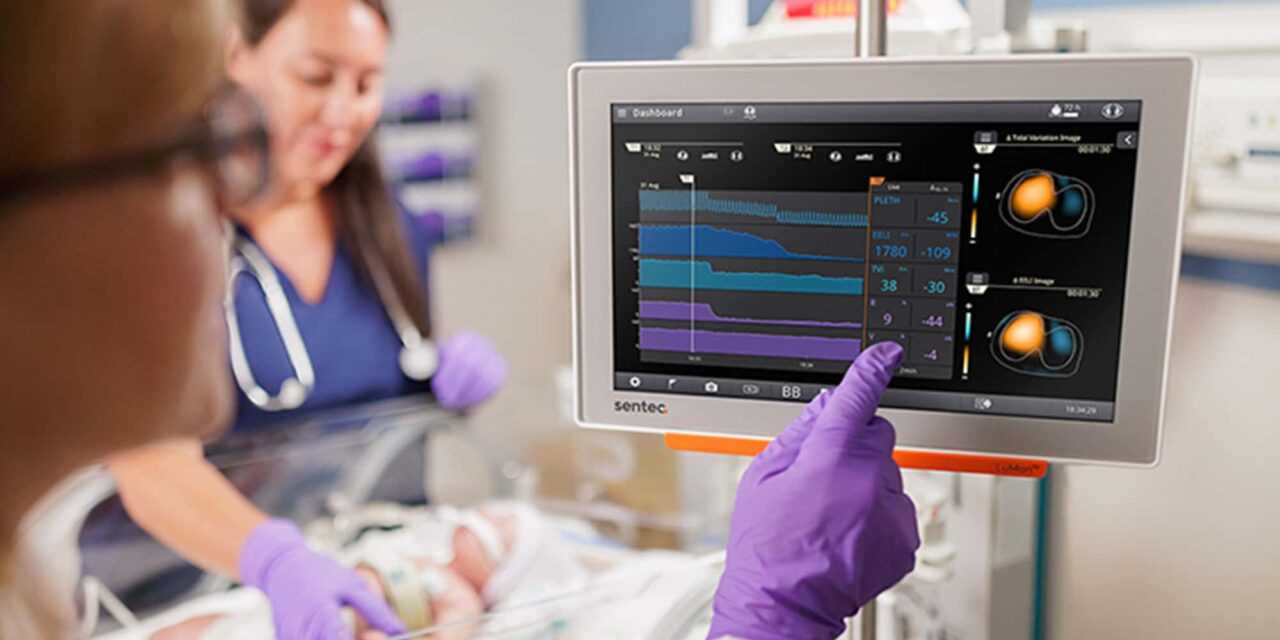
Sentec received FDA Clearance for its LuMon electrical impedance tomography (EIT) system, the first EIT system indicated for premature infants and spontaneously breathing patients in the US.
RT’s Three Key Takeaways:
- First FDA clearance for infants — The Sentec LuMon system is the first electrical impedance tomography (EIT) technology in the U.S. cleared for premature infants and spontaneously breathing patients.
- Radiation-free bedside imaging — Using a soft fabric belt, LuMon provides continuous, real-time images of lung function at the bedside, enabling safer and more precise respiratory care without radiation.
- Major impact on neonatal care — By visualizing ventilation in fragile premature infants, LuMon supports individualized interventions that may improve outcomes and reduce lifelong respiratory complications.
The US FDA has granted 510(k) clearance for Sentec’s LuMon electrical impedance tomography (EIT) system for premature infant, infant, adolescent, and adult patients, according to the company. The FDA clearance make Sentec’s LuMon the first EIT technology in the United States available for premature infants and for spontaneously breathing patients.
EIT works by sending gentle, alternating currents through the thorax via a comfortable, skin-friendly fabric belt and measuring the resulting voltages to produce dynamic images of regional impedance variations due to breathing. This enables clinicians to evaluate real-time responses to regional ventilation changes such as those resulting from positioning, ventilator settings, and pharmaceuticals, facilitating more precise and individualized care decisions.
The device delivers functional lung imaging directly at the bedside—without radiation—helping clinicians better tailor therapy to each patient’s unique needs, according to Sentec.
While the LuMon System can be used to monitor a variety of patients, whether ventilated or spontaneously breathing, the premature infants and other patients in the NICU may stand to benefit the most from EIT’s insights at the bedside, Sentec says.
“Neonatal patients present enormous complexity, especially for ventilation; there’s very little room for error, particularly in our smallest patients – and the consequences can follow these babies all their lives,” said Dr David Tingay, Clinical Neonatologist and Respiratory Physiotherapist at Royal Children’s Hospital in Melbourne, Australia. “Without EIT, there’s been no way for us to continuously see what is happening inside the lungs at the bedside to understand the impact of our interventions better as we perform them.”
The ability to safely visualize lung function at the bedside, continuously and in real time, has enormous potential for guiding neonatal care and, according to Tingay, “EIT provides immediate imaging of regional lung function at the bedside. That visualization helps us better understand each patient’s respiratory condition and determine the strategies we need to employ for their specific needs.”
Sentec says the FDA clearance along with availability of soft, fabric belts small enough for even very low birthweight infants, the LuMon System is positioned to help clinicians deliver gentle and effective respiratory care for the uniquely fragile and complex patients in the NICU.