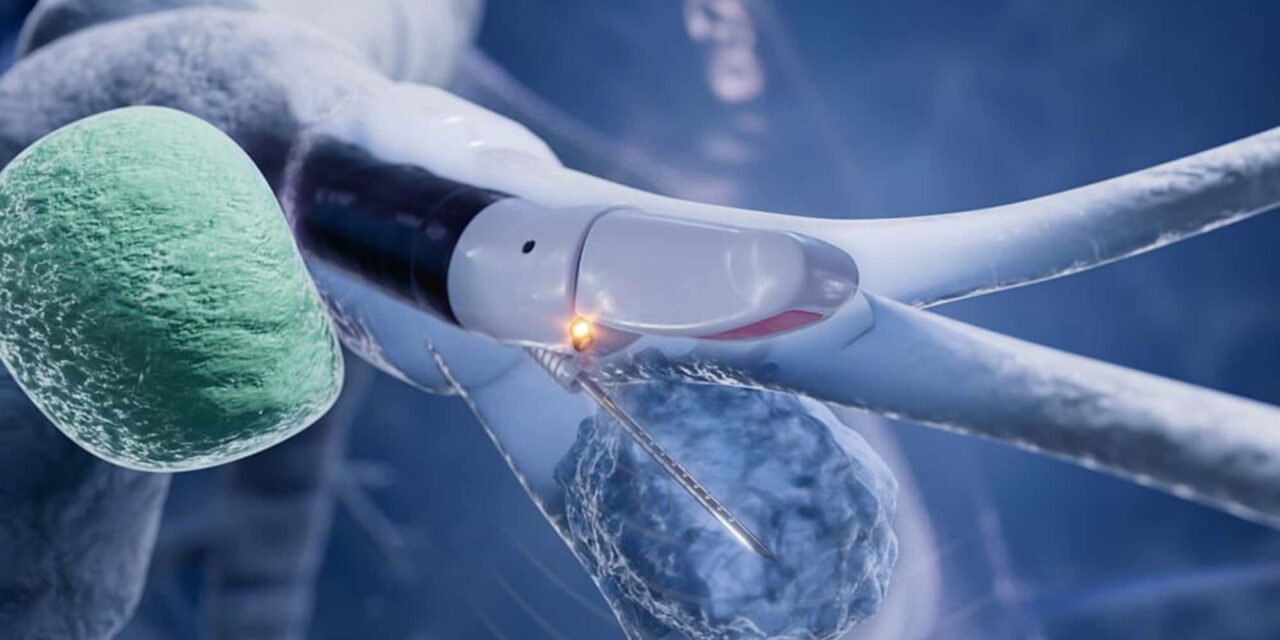
The new slim 5.9 mm diameter endobronchial ultrasound (EBUS) device is designed to access and sample tissue from hard-to-reach areas of the lungs.
RT’s Three Key Takeaways:
- Deeper Lung Access: The slim 5.9 mm bronchoscope reaches beyond central lymph nodes into segmental and sub-segmental airways to facilitate precise biopsies from peripheral lung regions.
- Enhanced Maneuverability: The device features an upward angulation of 170 degrees, a shorter distal end, and a 14-degree forward oblique view to navigate challenging anatomy, according to the company.
- Informed Cancer Care: Real-time tissue sampling in deeper pulmonary regions supports earlier diagnosis and next-generation genetic sequencing for targeted lung cancer therapies.
Olympus Corp has begun the US launch its BF-UCP190F bronchoscope, a slim 5.9 mm diameter endobronchial ultrasound (EBUS) device designed to reach beyond mediastinal lymph nodes into segmental and sub-segmental airways, according to the company.
The peripheral EBUS bronchoscope is designed to assist physicians in obtaining biopsies from deeper regions of the lungs during endobronchial ultrasound transbronchial needle aspiration (EBUS-TBNA) procedures, the company stated. During EBUS-TBNA, clinicians use real-time ultrasound imaging to visualize and sample targeted lesions or lymph nodes.
According to Olympus, EBUS-TBNA provides a less invasive alternative to mediastinoscopy while offering comparable diagnostic sensitivity for lung cancer evaluation. The company noted that samples collected via EBUS-TBNA are adequate for next-generation sequencing in 90.3% of cases, helping healthcare teams develop personalized treatment strategies.
“Extending the reach of EBUS technology beyond the central airway is an important new tool to help interventional pulmonologists diagnose and stage lung cancer with real-time image guidance,” said Thomas Gildea, global lead of medical affairs, respiratory, at Olympus Corp. “This opens the door for deeper access and better understanding of the many pulmonary diseases that can affect patients worldwide.”
Design Features and Specifications
The BF-UCP190F features an outer diameter of 5.9 mm at its distal end, allowing it to navigate farther into segmental and sub-segmental airways than the prior BF-UC190F model. The new bronchoscope also provides an upward angulation of 170 degrees—10 degrees wider than its predecessor—along with a 14-degree forward oblique viewing angle and a shorter distal end to facilitate access to anatomical locations that are difficult to reach.
In addition, the bronchoscope maintains compatibility with the ViziShot 2 25G EBUS-TBNA needle for real-time sampling and integrates with the EVIS X1 Endoscopy System and EU-ME3 Ultrasound Processor platforms, the company reported.
“As a pioneer in the field of endobronchial ultrasound, Olympus is excited to launch its latest EBUS bronchoscope, which enables pulmonologists to extend their diagnostic reach,” said Seiji Kuramoto, executive officer and surgical and interventional solutions division head at Olympus. “We are proud of the role Olympus has played in the field of interventional pulmonology, and the BF-UCP190F bronchoscope expands access to deeper lung regions while enabling real-time ultrasound-guided sampling, helping physicians obtain critical diagnostic information to support confident treatment decisions for their patients.”
Clinical Impact in Lung Cancer Staging
The clinical availability of peripheral sampling tools comes as lung cancer remains the leading cause of cancer-related mortality in the US, accounting for an estimated 229,410 new diagnoses and nearly 125,000 deaths this year, according to data cited by Olympus.
The company noted that the 5-year relative survival rate for non-small cell lung cancer is approximately 67% when detected at a localized stage, but falls to around 40% once the disease extends outside the lungs, underscoring the clinical value of early detection and accurate tissue sampling.
Olympus announced that it will showcase the BF-UCP190F bronchoscope at the American College of Chest Physicians (CHEST) annual meeting in Phoenix, scheduled for Oct. 19-21, 2026.