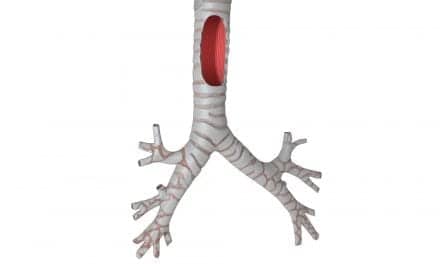

Data from more than 13,000 infants show that evaluating respiratory support past 40 weeks can help some patients avoid tracheostomy.
RT’s Three Key Takeaways:
- Evidence-Based Milestones: A study of more than 13,000 infants identified 40-week and 55-week postmenstrual age benchmarks to help medical teams evaluate whether patients can be successfully weaned from mechanical ventilation.
- Interdisciplinary Evaluation: Specialists across multiple disciplines, including respiratory therapy, track growth, cardiac strain, and ventilator settings every two to four weeks to avoid premature surgical interventions.
- Earlier Center Referrals: Physicians advise transferring infants with severe disease to specialized centers between 36 and 40 weeks postmenstrual age rather than waiting until several months later.
For infants diagnosed with severe bronchopulmonary dysplasia (BPD) who remain dependent on mechanical ventilation at 40 weeks postmenstrual age (PMA), placing a tracheostomy tube has long been considered the standard clinical path. However, specialists at Children’s Hospital Los Angeles (CHLA) have established new clinical milestones showing that this decision does not need to be rushed at the 40-week mark.
“Our data and our experience are showing that this decision often does not need to be made at 40 weeks,” said Narayan Iyer, MD, a neonatologist and co-director of the Infant Chronic Lung Disease Program in the Fetal and Neonatal Institute at CHLA. “For carefully selected patients, it can be made much further down the road.”
Key Age Milestones at 40 and 55 Weeks
Presented at the 2026 Pediatric Academic Societies conference, the CHLA study evaluated clinical data from more than 13,000 infants diagnosed with BPD to better determine weaning timelines and long-term respiratory outcomes. From this analysis, researchers outlined two distinct clinical benchmarks:
- 40 Weeks PMA: Most infants who required noninvasive modalities such as high-flow nasal cannula or nasal continuous positive airway pressure (CPAP) at 36 weeks PMA have successfully transitioned off respiratory support by this point. Infants who continue to require significant support at 40 weeks should receive a thorough clinical reassessment and potential referral to a specialized pediatric lung center.
- 55 Weeks PMA: Most infants who required invasive mechanical ventilation at 36 weeks PMA have been extubated and weaned by this milestone. For patients who remain ventilator-dependent at 55 weeks PMA, the statistical probability of weaning in the near term is low, providing healthcare providers and families with objective evidence to proceed with home mechanical ventilation via tracheostomy.
Collaborative Care and Frequent Reassessment
Rather than making immediate surgical decisions at 40 weeks PMA, the CHLA clinical team establishes individual treatment plans and re-evaluates each infant’s status every two to four weeks.
“If they’re getting better, however slowly, we’ll keep along this road,” said Iyer.
According to the hospital, this clinical strategy integrates neonatology, pulmonology, pulmonary hypertension, nutrition, developmental care, physical and occupational therapy, dysphagia management, nursing, respiratory therapy, pharmacy, and social work. The clinical care team reviews mechanical ventilator settings alongside systemic factors, including physical growth, developmental participation, sedation requirements, and indicators of cardiac strain or pulmonary hypertension.
“By taking a team approach, we can each share our expertise and perspective, and you get a much fuller picture of how the baby is doing,” said Manvi Bansal, MD, a pediatric pulmonologist and co-director of the Infant Chronic Lung Disease Program at CHLA.
Divergent Clinical Outcomes and Earlier Referrals
The hospital reported that two recent patients referred while invasively ventilated at approximately 40 weeks PMA followed very different paths under this protocol. With extended observation and close monitoring, one infant gradually improved and was discharged home several months later on supplemental oxygen rather than mechanical ventilation. A second infant experienced a plateau in progress, prompting clinicians to place a tracheostomy at 55 weeks PMA for long-term home ventilation.
“Agreeing to tracheostomy and long-term ventilation is a very hard decision for any family, but knowing our recommendation is grounded in our research and weeks of close multidisciplinary follow-up makes it a little easier,” said Iyer.
While tracheostomies carry procedural risks and place extensive operational demands on caregivers managing home ventilation, clinicians noted that indefinitely delaying a necessary procedure can hinder an infant’s developmental progress and family interaction.
To give infants the best opportunity to safely wean without unnecessary surgery, Iyer advised regional healthcare providers to refer infants with BPD to specialized centers between 36 and 40 weeks PMA if they remain intubated or depend on elevated levels of noninvasive support, especially if weight gain is suboptimal.
“Don’t wait until the baby is 7 or 8 months old,” said Iyer. “By referring earlier, we have more time to support the baby’s progress and provide the best possible chance of avoiding a tracheostomy later.”