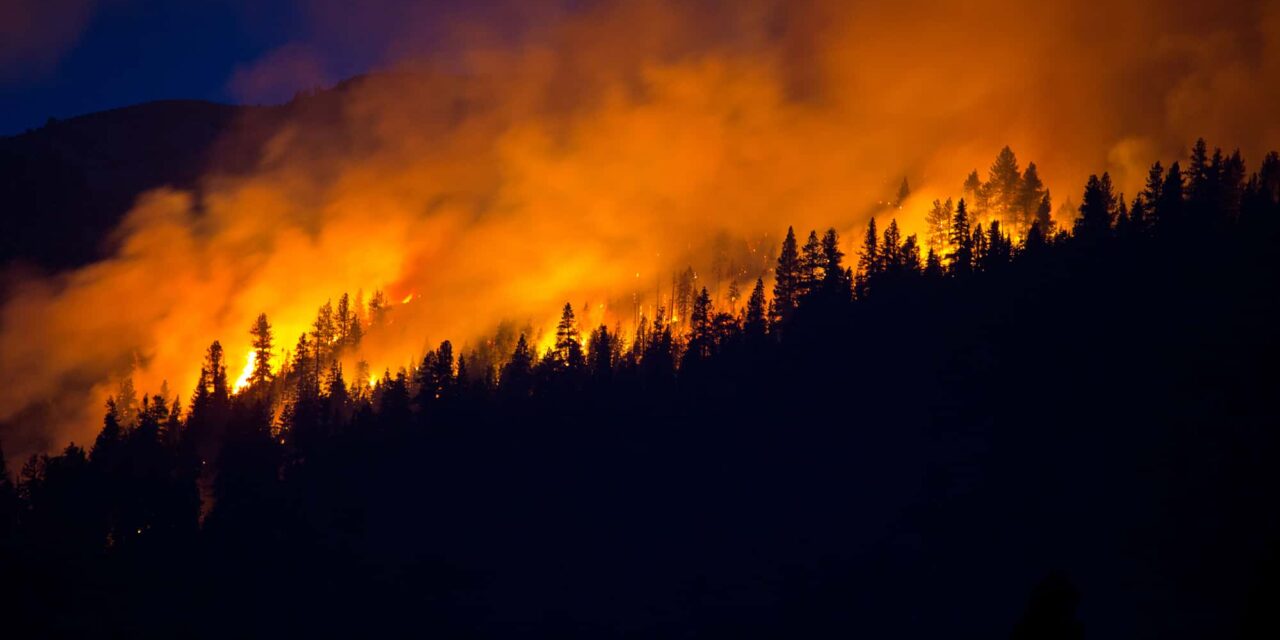
Two studies link fine particulate matter from wildfires to increased hospital admissions and lower lung cancer survival.
RT’s Three Key Takeaways:
- Higher Cardiopulmonary Risk: Exposure to fine particulate matter from wildfire smoke was linked to larger increases in hospital admissions for respiratory and cardiovascular conditions than equal concentrations of pollution from other sources.
- Reduced Cancer Survival: Among older patients diagnosed with lung cancer, particulate matter from wildfires accounted for an estimated 17% of total air pollution-related deaths despite representing only 4% of overall fine particulate exposure.
- Clinical Exposure Management: Investigators highlighted that respiratory clinicians and healthcare providers should consider tracking environmental smoke exposures and counseling vulnerable pulmonary patients during smoke events.
Wildfire smoke may present greater health hazards than other forms of air pollution, leading to higher rates of cardiopulmonary hospitalizations and reduced survival for lung cancer patients, according to two large-scale studies from the Icahn School of Medicine at Mount Sinai.
Published in Nature Communications and The Lancet Oncology, the studies evaluated long-term exposure to fine particulate matter (PM2.5)—microscopic particles measuring 2.5 micrometers or smaller that penetrate deep into lung tissue and enter the bloodstream. Both investigations determined that PM2.5 originating from wildfires showed greater health risks per unit of exposure than PM2.5 produced by traffic, industrial, or other non-wildfire sources, according to the researchers.
“Wildfire smoke is no longer a regional environmental issue. It is becoming a nationwide public health challenge,” said Yaguang Wei, PhD, assistant professor of environmental medicine at the Icahn School of Medicine at Mount Sinai and senior author of both studies, in a news release. “Our research shows that wildfire-related PM2.5 appears to be more harmful than equivalent levels of pollution from other sources. As wildfire activity increases, public health and environmental policies must account for both the quantity and the source of air pollution.”
Lower Survival Outcomes in Lung Cancer Patients
In the study published in The Lancet Oncology, investigators analyzed records from 414,016 adults aged 65 years and older with lung cancer using the Surveillance, Epidemiology, and End Results (SEER)-Medicare database. The study evaluated wildfire and non-wildfire PM2.5 exposures by residential location, comparing ambient estimates with models developed by Stanford University researchers.
The authors reported that while all PM2.5 exposure elevated mortality risks following a lung cancer diagnosis, wildfire PM2.5 showed disproportionate toxicity. Although smoke contributed roughly 4% of total PM2.5 exposure, it accounted for approximately 17% of total PM2.5-related deaths among participants, corresponding to hundreds of annual attributable deaths. Researchers also observed that an increased number of smoky days and extended exposure windows correlated with worsened survival.
“Patients with lung cancer are already medically vulnerable, and our findings suggest that wildfire smoke may place them at even greater risk,” said Min Zhang, PhD, postdoctoral fellow in the Department of Environmental Medicine at the Icahn School of Medicine at Mount Sinai and first author of the studies, in a news release. “As wildfire-related air pollution becomes more common, reducing exposure could become an increasingly important component of cancer care and survivorship planning.”
“For people with lung cancer or chronic heart and lung diseases, monitoring air quality and limiting exposure during smoke events may be especially important,” said Dr Wei, in a news release. “Health care providers may increasingly need to consider environmental exposures as part of comprehensive patient care.”
Increased Hospital Admissions for Cardiopulmonary Disease
In the second study, published in Nature Communications, researchers assessed hospitalization records from residents across 20 US states between 2006 and 2019. The dataset included more than 57 million cardiovascular hospitalizations and nearly 33 million pulmonary disease admissions.
Long-term exposure to wildfire-related PM2.5 was associated with increased risks of inpatient admission across several cardiopulmonary conditions, including asthma, chronic obstructive pulmonary disease (COPD), pneumonia, heart failure, ischemic heart disease, and hypertension. When matched for equal concentrations, wildfire PM2.5 was consistently tied to greater increases in hospitalization rates than non-wildfire emissions.
“We found that wildfire smoke can affect both the lungs and the cardiovascular system, and that its effects may be stronger than those of similar amounts of pollution from traffic, industry, and other sources,” said Dr Zhang, in a news release.
The study noted that these adverse associations were especially pronounced among racial and ethnic minority groups, residents of metropolitan regions, and individuals living in communities facing socioeconomic disadvantages and lower educational attainment.
The research teams stated that future investigations will focus on isolating the specific chemical components within wildfire particulate matter driving its elevated toxicity, as well as clarifying the biological mechanisms that degrade cardiovascular and respiratory function.