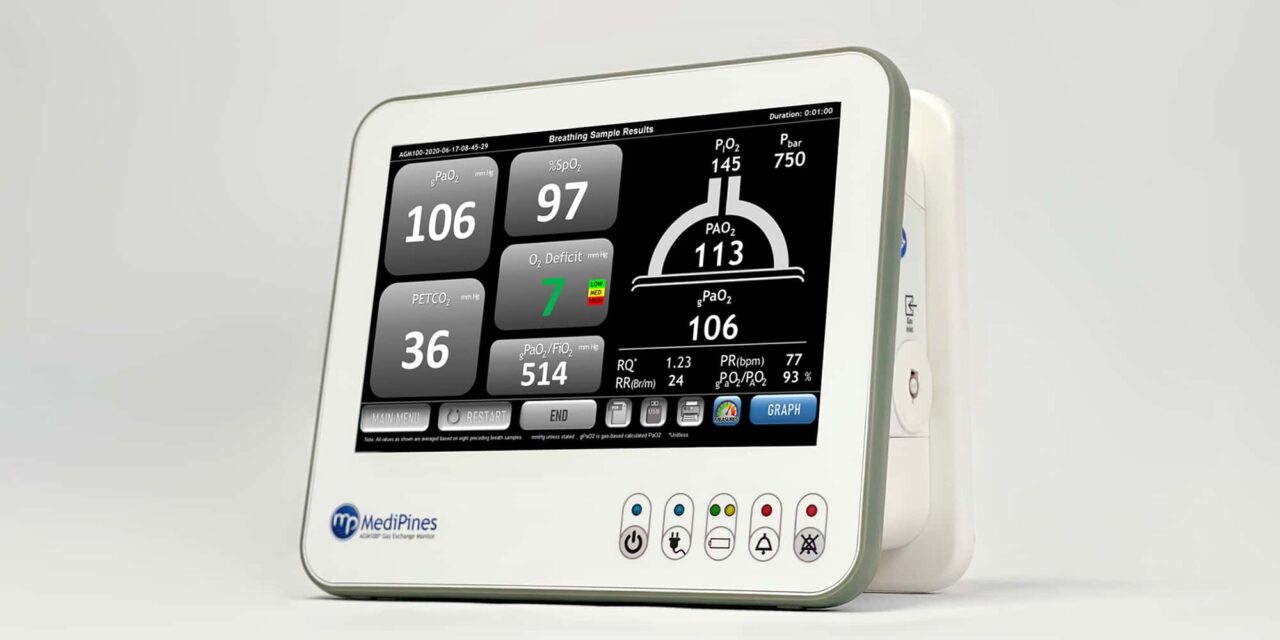
The Centers for Medicare & Medicaid Services finalized an average reimbursement of $150 for noninvasive lung gas exchange assessments starting in 2027.
RT’s Three Key Takeaways:
- Payment Rate Increase: The Centers for Medicare & Medicaid Services finalized an increase in the 2027 Medicare hospital outpatient facility payment to a national average rate of $150 for noninvasive cardiorespiratory assessment using MediPines AGM100 technology.
- Point-of-Care Assessment: The noninvasive breathing test evaluates ventilation, blood oxygenation, and gas exchange efficiency to assist healthcare clinicians in determining respiratory impairment severity and guiding intervention decisions.
- Predictive Performance: A National Institutes of Health-funded study showed that the device’s Oxygen Deficit measure predicted the need for supplemental oxygen within 24 hours among emergency department patients.
The Centers for Medicare & Medicaid Services (CMS) has finalized an increase in the 2027 Medicare hospital outpatient facility payment for noninvasive cardiorespiratory assessment using the MediPines AGM100 pulmonary gas exchange technology, according to the company.
The updated national average rate is set at $150 for Current Procedural Terminology (CPT) code 0893T, which describes the noninvasive assessment of blood oxygenation, gas exchange efficiency, and cardiorespiratory status, MediPines announced. The service is assigned to Ambulatory Payment Classification APC 5734 for hospital outpatient services. The company stated that the $150 rate applies specifically to the hospital outpatient facility fee, while reimbursement for professional services is determined separately.
Point-of-Care Gas Exchange Assessment
According to MediPines, the AGM100 is cleared by the FDA to measure Oxygen Deficit, a noninvasive parameter reflecting respiratory impairment severity and serving as a surrogate for the alveolar–arterial oxygen difference (AaDO₂). The system assesses gas exchange—the primary physiological function of the lungs—during a single, brief testing session.
Utilized across emergency departments, hospital units, and outpatient clinics, the noninvasive breathing test evaluates how effectively the lungs transfer oxygen into circulating blood, the company reported. MediPines indicated that clinicians use this information to support diagnostic and treatment decisions, evaluate patient response to therapies, and establish whether escalation of care is warranted.
Clinical Validation and Emergency Care Utility
The payment determination follows a study funded by the National Institutes of Health (NIH) and published in the Journal of Clinical Medicine, according to MediPines. Conducted across the emergency departments of two academic medical centers, the trial evaluated Oxygen Deficit as an early indicator of respiratory deterioration requiring clinical intervention, using the requirement for supplemental oxygen within 24 hours as the primary marker of deterioration.
In that investigation, Oxygen Deficit predicted the need for oxygen therapy with an area under the receiver operating characteristic curve (AUROC) of 0.94 and remained a statistically significant predictor in multivariable analysis (p < 0.001). Study authors McGuire et al reported that the AGM100 provides prognostic information “with a fidelity that exceeds or matches the accuracy of the best predictive tools for respiratory failure in the published literature.”
“These findings are significant for hospital outpatient and emergency care,” said Steve Lee, chief executive officer of MediPines, in a news release. “Patients with a COPD exacerbation, heart failure, or pulmonary embolism can come in with similar symptoms, but the degree of gas exchange impairment can vary, impacting clinical decisions. That’s why assessing gas exchange at the point of care matters.”