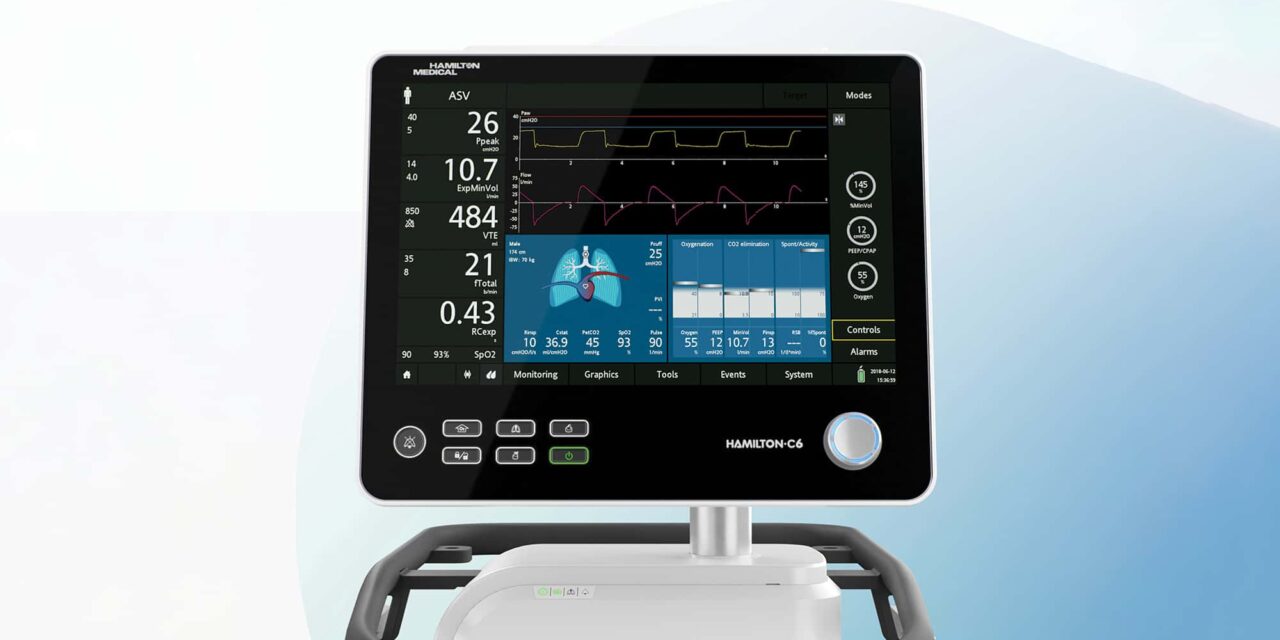
The Hamilton-C6 includes automated ventilation modes and a turbine-driven design to support mobility and patient-ventilator synchrony.
RT’s Three Key Takeaways:
- Adaptive Support Ventilation: The system utilizes ASV technology to adjust respiratory rate and tidal volume breath by breath, a process shown to reduce the duration of mechanical ventilation.
- Independent Mobility: A high-performance turbine allows the ventilator to operate without high-pressure air outlets or external compressors, supporting patient movement and early mobilization.
- Enhanced Synchrony: The IntelliSync+ feature analyzes waveform signals 100 times per second to detect patient effort and initiate inspiration and expiration in real-time.
Hamilton Medical has developed the Hamilton-C6, a modular intensive care unit (ICU) ventilator designed to provide intelligent ventilation solutions across patient populations, according to the company. The device supports therapy for neonates through adults, offering both invasive and noninvasive ventilation in various healthcare settings.
The ventilator utilizes a high-performance turbine, making it independent from external compressors and high-pressure air outlets. This design allows for increased mobility within the hospital, supporting early mobilization of patients. The device operates at an average of 35 dB to minimize noise in the patient environment.
A primary feature of the system is Adaptive Support Ventilation (ASV), which adjusts respiratory parameters breath by breath based on lung mechanics and patient effort. “Adaptive Support Ventilation (ASV) is a ventilation mode that provides continuous adaptation of respiratory rate, tidal volume, and inspiratory time, depending on the patient’s lung mechanics and effort,” said Hamilton Medical in a news release. The company noted that ASV has been shown to reduce the duration of mechanical ventilation in various patient populations with fewer manual settings.
To improve patient-ventilator synchrony, the device includes IntelliSync+, which analyzes waveform signals at least 100 times per second to detect patient efforts and initiate inspiration and expiration in real-time. Additionally, the integrated IntelliCuff technology automatically maintains user-set cuff pressure for endotracheal or tracheostomy tubes.
The user interface is designed to integrate data into visualizations. “One of the pearls of these ventilators is the interface. I think the interface of the Hamilton-C6 has a completely new level of monitoring capabilities,” said João Alves, intensivist, in a news release.
Other features include a P/V Tool for lung assessment, transpulmonary pressure monitoring, and an optional integrated Aerogen nebulizer. The device also offers high flow nasal cannula therapy and volumetric capnography to assess ventilation quality and metabolic activity. The ventilator includes connectivity solutions for patient data management systems (PDMS), monitoring, and electronic systems.
Source
- https://respiratory-therapy.com/products-treatment/monitoring-treatment/therapy-devices/products-2025-ventilators-critical-care-accessories/
- https://www.hamilton-medical.com/en_US/Products/HAMILTON-C6.html