
GE’s Critical Care Suite 3.0 adds pediatric capabilities and provides bedside feeding tube placement detection without requiring cloud connectivity.
RT’s Three Key Takeaways:
- Pediatric Expansion: Critical Care Suite 3.0 received 510(k) clearance from the FDA to detect feeding tubes in both pediatric and adult patients directly on mobile X-ray devices.
- Bedside Processing: The on-device artificial intelligence evaluates tube placement at the point of care without requiring internet or cloud connectivity.
- High Localization Accuracy: In clinical testing, the algorithm demonstrated 99.2% sensitivity for tube detection and 91.6% mean DICE localization relative to expert radiologist annotations.
GE HealthCare has received 510(k) clearance from the USFDA for Critical Care Suite 3.0, an artificial intelligence software designed to automatically detect feeding tubes on mobile X-ray images in adult and pediatric patients, according to the company.
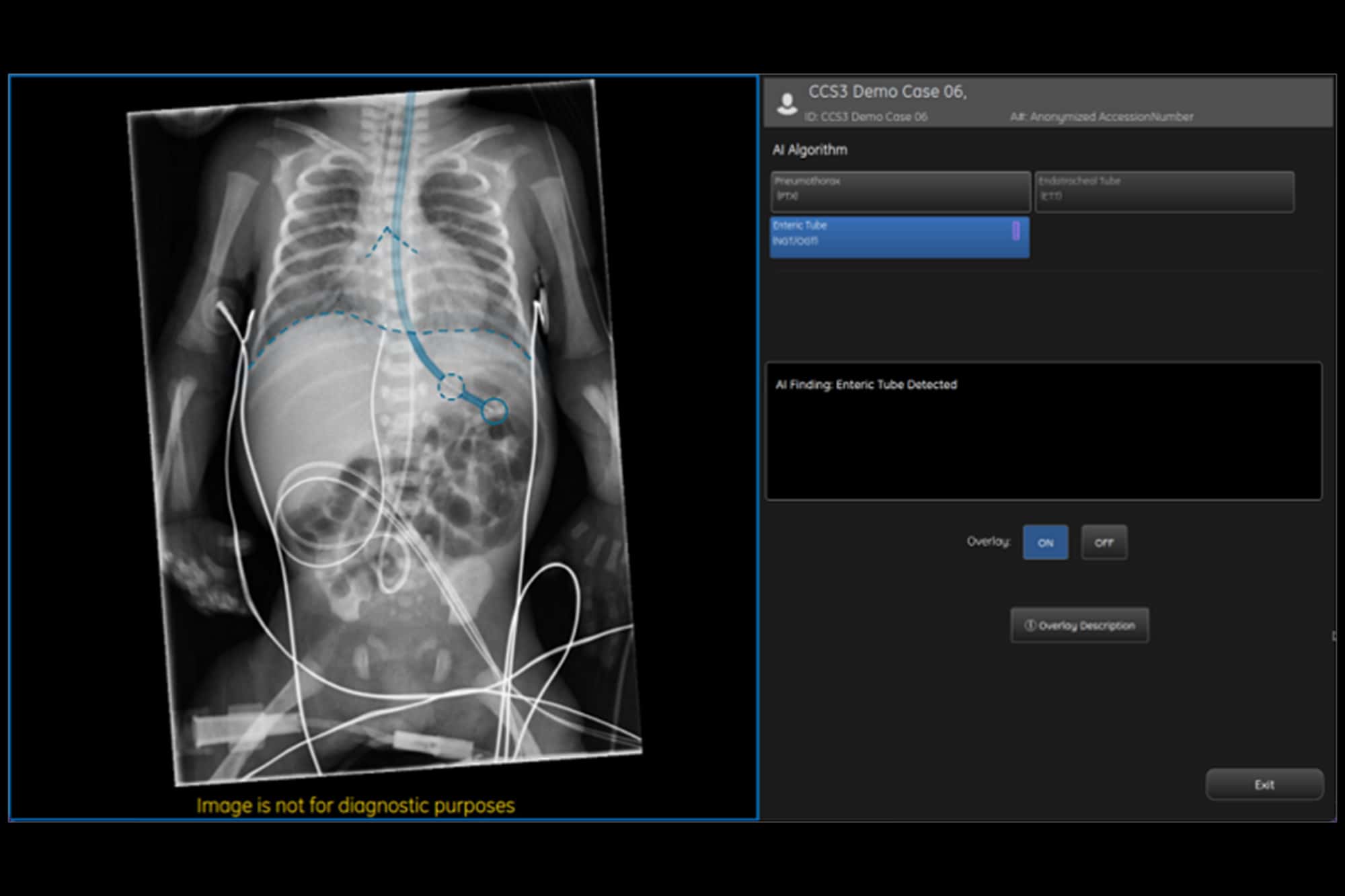
Embedded directly onto mobile X-ray devices, the technology assists clinicians in assessing enteric tube tip and side-port positioning at the bedside without requiring cloud or internet connectivity, the company stated.
Mobile imaging remains central to intensive care and emergency settings, representing 75% of mobile X-ray usage in emergency departments and 51% in intensive care units, according to GE HealthCare. In addition, research cited in the announcement estimates that 80% of intensive care unit patients receive enteral nutrition via nasogastric or nasoenteric tubes. Verifying proper placement is critical for care teams, as malpositioned tubes can result in serious clinical complications.
Because pediatric X-ray imaging requires specific consideration of patient size, anatomy, and protocols, Critical Care Suite 3.0 broadens the algorithm’s capabilities to include pediatric patients for the first time, according to GE HealthCare.
“Critical care teams need to make timely clinical decisions in complex, rapidly changing environments when every minute counts. Critical Care Suite 3.0 reflects our focus on embedding intuitive AI into existing X-ray imaging workflows to help bring useful information closer to clinicians at the bedside,” said Larry Boyd, vice president and general manager, global X-ray, GE HealthCare. “Expanding the algorithm portfolio to include feeding tube assessment capabilities for pediatric patients is an important step in supporting care teams across a broader range of patients with technology designed to fit naturally into the way they work.”
The software detects enteric tubes by identifying the tube path, tip, and side port while highlighting anatomical reference points such as the diaphragm and airways, according to the manufacturer. Testing conducted by the company showed that the algorithm achieved 99.2% sensitivity for tube detection and a 91.6% mean DICE localization score, measuring alignment between the automated outlines and annotations by expert radiologists.
“Critical Care Suite 3.0 gives our team access to feeding tube assessment information right at the bedside, supporting more timely clinical decisions and better patient care,” said Adam Walbrun, clinical manager, imaging services, at Emplify Health in La Crosse, Wisconsin. “Our providers see the value firsthand and frequently request the portable X-ray system equipped with this technology.”
Critical Care Suite 3.0 expands on previous iterations of the software portfolio, which includes automated measurements, case prioritization, and quality control features aimed at reducing imaging errors and improving workflow efficiency across critical care environments.