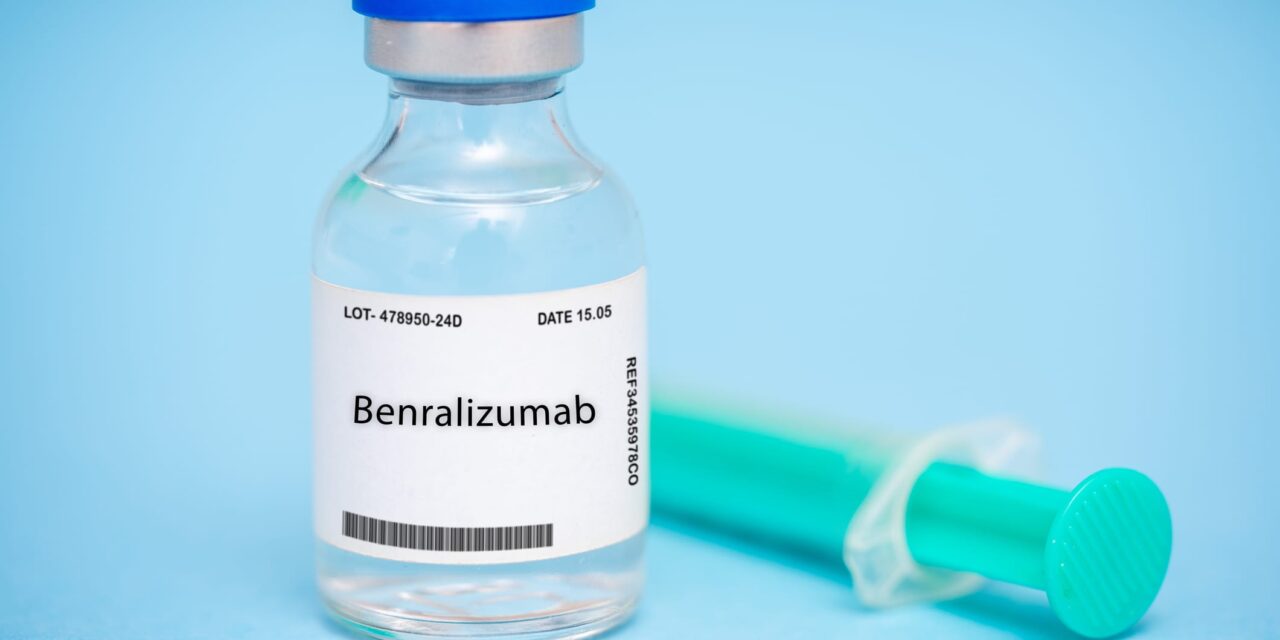
A Phase III NATRON trial found Fasenra (benralizumab) had benefits for patients with hypereosinophilic syndrome (HES).
RT’s Three Key Takeaways:
- Robust Clinical Benefit – The Phase III NATRON trial showed that Fasenra significantly delayed time to first HES worsening/flare and reduced flare risk by 65% versus placebo with a single monthly dose.
- Meaningful Symptom Improvement – Fasenra met all key secondary endpoints, including fewer flares, delayed hematologic relapse, and notably greater improvement in fatigue, beginning at Week 4 and persisting through Week 24.
- Expanding Impact in Eosinophilic Disease – Supported by consistent safety results, these data reinforce Fasenra’s potential to address eosinophilic inflammation in rare, difficult-to-treat diseases as AstraZeneca advances regulatory filings for HES.
Positive full results from the NATRON Phase III trial showed AstraZeneca’s Fasenra (benralizumab) demonstrated a statistically significant delay in the time to first worsening or flare in hypereosinophilic syndrome (HES),1 a rare disease driven by elevated eosinophils.2 These data will be presented at the American College of Allergy, Asthma and Immunology (ACAAI) 2025 Annual Scientific Meeting in Orlando, Florida.
Hypereosinophilic Syndrome (HES) is a group of rare disorders characterised by persistent, significantly elevated levels of eosinophils (a type of white blood cell) in the blood and evidence of eosinophil-mediated organ or tissue damage.2 This may lead to progressive organ damage over time and if left untreated, may be fatal.2 Current treatments include glucocorticosteroids, chemotherapy medicines, tyrosine kinase inhibitors and an anti-interleukin-5 (IL-5) monoclonal antibody.2
NATRON was a Phase III trial evaluating the efficacy and safety of Fasenra in patients with HES.3 Patients were randomized to receive either a single 30 mg subcutaneous injection of Fasenra or a placebo once every four weeks.3 The trial successfully met the primary endpoint, as treatment with Fasenra delayed the time to first HES worsening/flare and significantly reduced the risk of HES worsening/flare compared to placebo by 65% (19.4% vs 42.4% events; HR 0.35;95% CI: 0.18, 0.69; P=0.0024).1
Princess U. Ogbogu, Division Chief of Pediatric Allergy, Immunology, and Rheumatology at University Hospitals Rainbow Babies and Children’s Hospital and Case Western Reserve University, Cleveland, OH, the trial’s principal investigator, said: “From my years of treating patients with hypereosinophilic syndrome, I know first-hand how devastating HES symptoms can be, including fatigue, organ involvement and impacts on quality of life. The NATRON results suggest we have the potential to help HES patients with benralizumab, significantly reduce the risk of flares, hematologic relapse and improve fatigue severity compared to placebo with a single monthly dose regime.”
Sharon Barr, Executive Vice President, BioPharmaceuticals R&D, AstraZeneca, said: “The NATRON results confirm Fasenra’s ability to address eosinophilic inflammation in difficult to treat eosinophilic-driven diseases, like HES and eosinophilic granulomatosis with polyangiitis, in addition to severe eosinophilic asthma. By sharing the full results from NATRON with the medical community today and progressing our regulatory filing, we hope to realise a future in which Fasenra helps patients with HES who currently have very limited options.”
All key secondary endpoints in the trial were also met, as treatment with Fasenra resulted in fewer proportion of patients experiencing a flare or withdrawing (22.4% vs 45.5%; odds ratio: 0.31; 95% CI: 0.14, 0.69; P=0.0033) and a 66% reduction in the annualised rate of HES flares compared to placebo: 0.41 vs 1.23 flares per year, respectively (rate ratio: 0.34; 95% CI: 0.18, 0.63; P=0.0008).1 Time to first hematologic relapse was delayed for patients on Fasenra compared to placebo (hazard ratio: 0.08; 95% CI: 0.03, 0.20; P<0.0001).1 A greater improvement in PROMIS Fatigue scores was observed in patients treated with Fasenra compared to placebo by Week 4 and persisted to Week 24 (least squares mean difference: -4.72; 95% CI: –7.64, –1.80; P=0.0017).1
Data from NATRON will also be shared at the upcoming American Society of Haematology (ASH) Annual Meeting and Exposition in December 2025.
The safety and tolerability profile for Fasenra in the NATRON trial was consistent with the known profile of the medicine.4,5
Fasenra is currently approved as an add-on maintenance treatment for severe eosinophilic asthma (SEA) in more than 80 countries, including the US, Japan, EU and China.6-10 It is also approved for SEA in children and adolescents ages six and above in the US and Japan.10 Fasenra is also approved in more than 60 countries for the treatment of adults with eosinophilic granulomatosis with polyangiitis (EGPA).11
Notes
Hypereosinophilic Syndrome
People with HES experience a wide variety of symptoms depending on the organs that are impacted, which can make it difficult to diagnose.2 Symptoms may include weight loss, fevers, night sweats, fatigue, cough, chest pain, swelling, stomach ache, rash, muscle pain, weakness, confusion and coma, which can progress to organ or tissue damage over time.2,12,13 The true incidence and prevalence of HES remains unknown,2 but it is estimated that the incidence in the UK of HES ranges from <0.04–0.17 per 100,000 person‐years and the prevalence ranges from 0.15–0.89 cases per 100,000 persons.14
Phase III NATRON Trial
NATRON was a phase III, multicenter, randomized, double-blind, parallel-group, placebo-controlled study evaluating the efficacy and safety of Fasenra 30 mg versus placebo administered subcutaneously every four weeks in eligible people with HES.3 The primary efficacy endpoint was time to first HES worsening/flare defined as HES clinical manifestations or lab abnormalities that result in an increase/burst of oral corticosteroids (OCS)≥10 mg/day for at least 2 days, or an increase or addition of new cytotoxic and/or immunosuppressive therapy or hospitalization.3
Participants (n=133) were randomized in a 1:1 ratio to receive Fasenra (30 mg or placebo every 4 weeks for 24 weeks Double Blind treatment period), in addition to background HES therapy.3
The trial successfully met the primary endpoint, as treatment with Fasenra delayed the time to first HES worsening/flare and significantly reduced the risk of HES worsening/flare compared to placebo by 65% (19.4% vs 42.4% events; HR 0.35; 95% CI: 0.18, 0.69; P=0.0024).1 Key secondary endpoints included the proportion of patients with HES flares, annualized rate of HES flares, time to first hematological relapse (AEC ≥1×10⁹/L), and change from baseline to Week 24 in PROMIS Fatigue scores.3
References
- Ogbogu, P, et al. Benralizumab For Patients With Hypereosinophilic Syndrome: A Randomized Double-Blind Placebo-Controlled Phase 3 Trial (NATRON). Presented at the American College of Allergy, Asthma, & Immunology (ACAAI) Annual Scientific Meeting; 2025 6-10 November; Orlando, FL.
- Mikhail ES and Ghatol A. Hypereosinophilic Syndrome. StatPearls Publishing; 2024. Accessed October 2025.
- ClinicalTrials.Gov. A Phase III Study to Evaluate the Efficacy and Safety of Benralizumab in Patients With Hypereosinophilic Syndrome (HES) (NATRON). Available at: https://clinicaltrials.gov/study/NCT04191304. Accessed October 2025.
- Kuang FL, et al. Benralizumab for PDGFRA-Negative Hypereosinophilic Syndrome. N Engl J Med. 2019;380(14):1336–46.
- Wechsler ME, et al. Benralizumab versus Mepolizumab for Eosinophilic Granulomatosis with Polyangiitis. N Engl J Med. 2024;390(10):911-921.
- Fasenra (benralizumab) US prescribing information. Available at: https://www.accessdata.fda.gov/drugsatfda_docs/label/2024/761070s021lbl.pdf. Accessed October 2025.
- EMA Fasenra Product Information. Available at: https://www.ema.europa.eu/en/documents/product-information/fasenra-epar-product-information_en.pdf. Accessed October 2025.
- AstraZeneca news release. Available at: https://www.astrazeneca.com/media-centre/press-releases/2024/fasenra-approved-in-china-for-the-treatment-of-severe-eosinophilic-asthma.html. Accessed October 2025.
- AstraZeneca news release. Available at: https://www.astrazeneca.com/media-centre/press-releases/2018/fasenra-recieves-approval-in-japan-19012018.html. Accessed October 2025.
- AstraZeneca Annual Report 2024. Available at: https://www.astrazeneca.com/investor-relations/annual-reports/annual-report-2024.html. Accessed October 2025.
- AstraZeneca Data on File. 2025. Fasenra Program Update August 2025. REF-287072.
- UpToDate. Hypereosinophilic syndromes: Clinical manifestations, pathophysiology, and diagnosis. https://www.uptodate.com/contents/hypereosinophilic-syndromes-clinical-manifestations-pathophysiology-and-diagnosis. Accessed October 2025.
- MSD Manuals. Eosinophilic Disorders. Available at: https://www.msdmanuals.com/home/blood-disorders/white-blood-cell-disorders/eosinophilic-disorders. Accessed October 2025.
- Requena G, et al. The increasing incidence and prevalence of hypereosinophilic syndrome in the United Kingdom. Immun Inflamm Dis. 2021; 9(4):1447–51.