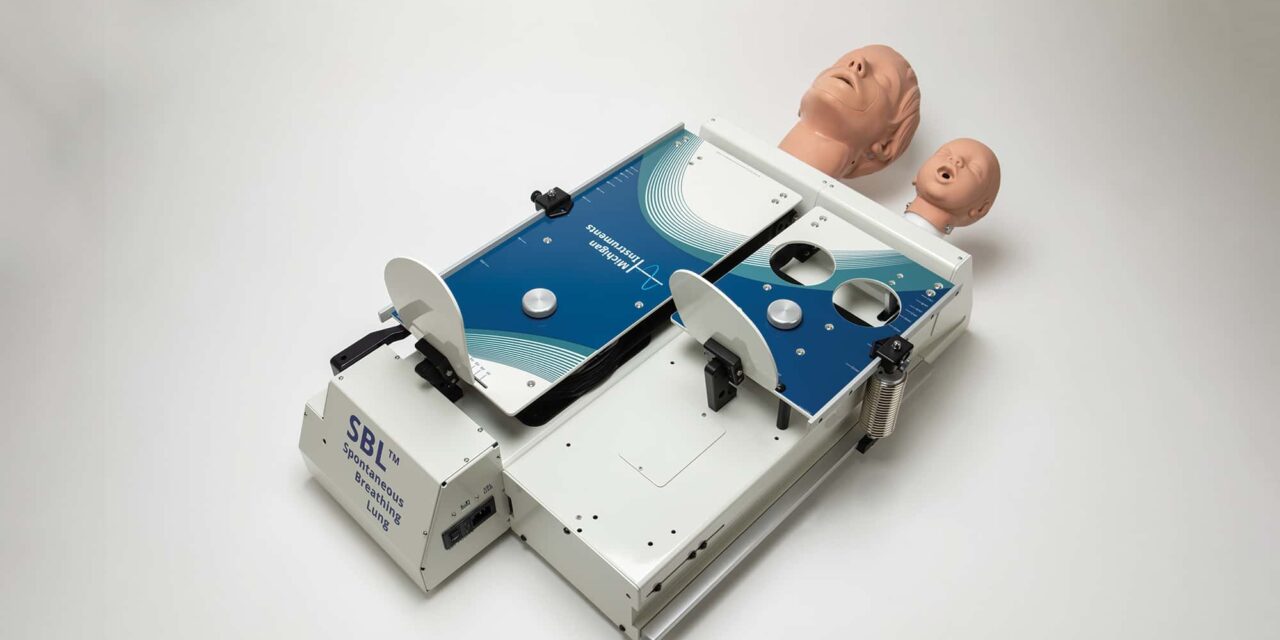
The Michigan Instruments adult lung simulators provide representations of pulmonary mechanics to help clinicians and engineers simulate respiratory diseases.
RT’s Three Key Takeaways:
- Realistic Pulmonary Simulation: The simulators provide accurate representations of human pulmonary mechanics, allowing any ventilator to trigger and respond as it would with a live patient.
- Customizable Disease Modeling: Each lung in the dual adult simulator can be independently adjusted for compliance and airway resistance to model symmetrical or asymmetrical lung diseases.
- Versatile Clinical Applications: These devices are used for clinical training on mechanical ventilation, performance testing by biomedical engineers, and research and development for new respiratory technologies.
Michigan Instruments is offering advanced artificial lung simulators designed to provide representations of human pulmonary mechanics for respiratory disease simulation across a range of patients, according to the company.
The simulators, available in adult and infant models, allow users to connect any ventilator to the device, which then triggers and responds as it would on a real patient, the company stated. The adult models are available in single or dual configurations and replicate the total lung capacity of a typical adult patient.
For the dual adult simulator, each lung can be independently adjusted for compliance and airway resistance. This feature allows for the simulation of symmetrical or asymmetrical lung disease, with results that are visible and monitored through the system. Both the single and dual devices are available with or without PneuView electronics and software, according to Michigan Instruments.
To create spontaneous breathing scenarios, the models can be equipped with a spontaneous breathing lung (SBL) module. This addition allows the simulator to mimic patient demand and related clinical scenarios. Furthermore, an adult head simulation module (HSM-A) can be added to expand the applications of the system, the company stated.
According to Michigan Instruments, the simulators serve three primary functions: training, testing, and research and development. In training environments, the devices allow for hands-on instruction on ventilator use and respiratory care. Biomedical engineers, manufacturers, and service companies use the simulators for performance testing of mechanical ventilators and other respiratory healthcare devices as part of quality control programs.
Technical specifications for the adult lung simulator include a breath rate range of 2 to 1,100 breaths per minute (BPM) with an accuracy of plus or minus 1 BPM, according to the company. Tidal volumes range from 100 mL to 2 L for single models and up to 4 L for dual models. Compliance ranges from .01 to .10 L/cmH2O, and resistance settings include Rp5, Rp10, Rp20, and Rp50 cmH2O/L/sec.
Source:
- https://respiratory-therapy.com/products-treatment/diagnostics-testing/training/products-2025-simulation-test-lungs/
- https://www.michiganinstruments.com/lung-simulators/