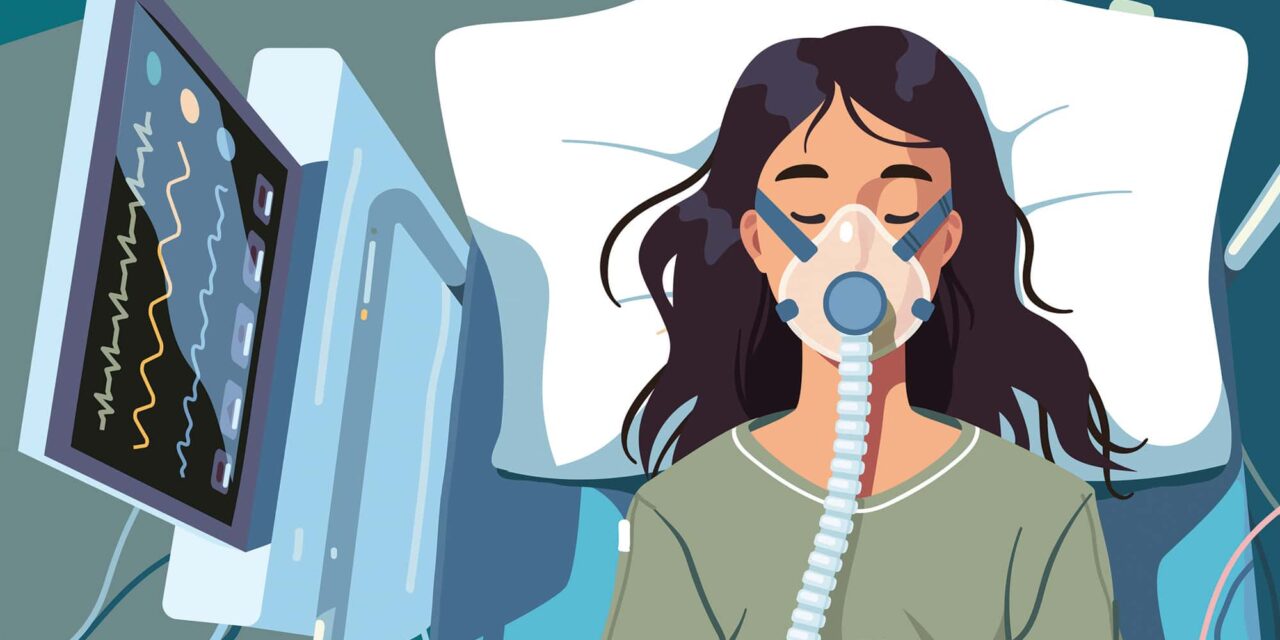
Home RTs play a key role in driving the success of patients on home mechanical ventilation. Their responsibilities range from setting up and adjusting ventilators to troubleshooting equipment issues, fitting masks or managing tracheostomies, and educating patients and caregivers.
By Alyx Arnett
Home mechanical ventilation is a lifeline for patients with chronic respiratory diseases, providing essential support that allows them to live outside hospital settings. Its use has grown steadily, fueled by advancements in ventilator technology, greater recognition of its clinical benefits, and a growing need for alternatives to prolonged hospital stays.1
Noninvasive ventilation (NIV) offers respiratory support without needing a tracheostomy, while invasive ventilation remains necessary for patients with more advanced respiratory disease. Roxanne Venard, RRT, president of Ascent Respiratory Care and chair of AAHomeCare’s Home Medical Equipment and Respiratory Therapy Council, said that improvements in NIV—along with catching patients’ diseases states earlier—have helped reduce the number of patients requiring invasive support. “We are now getting really good at ventilating people noninvasively,” she said.
Home respiratory therapists (RTs) play a key role in driving the success of patients on home mechanical ventilation. Their responsibilities range from setting up and adjusting ventilators to troubleshooting equipment issues, fitting masks or managing tracheostomies, and educating patients and caregivers. Experts in the field offer tips for ensuring success throughout this care process.

Transitioning from Hospital to Home
Before transitioning a patient from the hospital to home, it’s essential to make sure the patient is stable and that their prescribed ventilator settings can be achieved at home—prior to the patient getting there, said Stacey Jackson, RRT, RCP, director of clinical operations at Quipt Home Medical.
“Never take a patient home that’s unstable,” Jackson said, noting that oxygen demands should be down (<40% FiO2), and positive end-expiratory pressure should be under 10 cmH2O. “We look at those two things really heavily and, then on top of that, making sure they have adequate tidal volume. We generally aim for eight to 10 mL per kg, but always take into account the patient’s disease state and how it may progress.”
Jackson also said to ensure the patient has a minimum of two caregivers and that the home environment is equipped to handle the ventilator equipment and power requirements. “We need to make sure these homes are ready for that before we start them there,” Jackson said.
Caregiver training and education must begin before the patient’s transition home, according to Brenda May, RRT, pulmonary coordinator A6N/Respiratory Care at Methodist Hospital at IU Health. “Once the families have their training on that in the home, then we make sure they’re able to manage it before discharge here at the hospital,” May said.
For pediatric patients on invasive ventilation, caregiver training can be especially extensive. At Riley Hospital for Children at IU Health, caregivers must first complete pre-work—which includes learning the fundamentals of tracheostomy care, stoma care, suctioning, medication administration, and CPR—before moving on to hands-on training with home ventilator equipment, said Aimee Ealy, RRT, pediatric critical care supervisor of respiratory care at Riley Hospital for Children. Caregivers must complete one eight-hour shift and two 24-hour shifts caring for the child in the hospital before discharge. “And we really try to mimic what it looks like at home,” Ealy said. “We want them to be completely independent on how to care for their baby.”
Once home, ongoing education remains essential. “It continues throughout their whole life, really,” Venard said.
Types of Home Ventilators
Several ventilator models, offering both invasive and noninvasive modes, are commonly used in home care. These include ResMed’s Astral series, Breas’ Vivo 45LS, React Health’s V*Home series, and Movair’s Luisa.
Notably, Philips is discontinuing its home ventilators, which have been widely used and recognized in the industry. “That has created a huge vacuum for home vents,” said Ealy. Philips’ Trilogy 100, 200, and 202 portable ventilators, which stopped being sold in December 2020, will go out of service in December 2025. Meanwhile, the Trilogy EVO and EV300, sold until Jan 25, 2024, have a Jan 25, 2029, end-of-service date.
With support ending for the Trilogy 100, 200, and 202 ventilators at the end of the year, Venard encourages RTs to work with patients to get them comfortable with the device they will be switching to. She notes that many patients have used these ventilators for years and are accustomed to how they deliver therapy. “Know the advantages and the limitations of the ventilator that you’re going to be using. How can you manipulate the settings to be more comfortable for the patient?” Venard said. “We need to make sure that all the patients are able to transition. And if they can’t transition to one particular vent, then maybe we need to try a different one.”
Today’s home ventilators offer a range of settings and features, including remote monitoring capabilities. ResMed’s Astral, through its connectivity module, enables clinicians to remotely track patients via AirView. “With straightforward access to device and therapy data, you can identify problems and intervene quickly if the patient requires assistance,” said Charles Hartson, vice president of product management – consumer solutions at ResMed.
The Vivo 45LS stands out for its integrated humidifier, a first for home ventilators. Meanwhile, Jackson highlights the ability to use high-flow nasal cannula—which delivers a high-flow blend of oxygen and air via a nasal cannula to improve oxygenation—as a secondary mode with V*Home as particularly beneficial for COPD patients with rapidly progressing disease. “A lot of times they end up in the hospital when they’re really hungry for air,” Jackson said. “They get a lot of oxygen pushed at them when, in reality, all they need is a lot more flow.” Other home ventilators also offer high-flow oxygen therapy.
Masking the Way to Success in Home NIV
Mask selection can make or break success in home NIV. A poor fit can lead to discomfort, air leaks, and poor adherence. Remote mask fitting solutions, which utilize smartphone-based facial scanning and patient questionnaires to recommend optimal mask options, have gained traction in recent years. These technologies aim to improve initial fit accuracy.
Among these solutions is SleepGlad, which uses machine learning to take thousands of topographical measurements of a patient’s facial structure to recommend the best NIV (as well as CPAP) mask fit. The technology’s accurate rate is 97%, yielding a 3% refit rate—well below the industry average of around 22-25%, said Tim Bethany, vice president of SleepGlad, which VGM recently acquired.
Boone Lockard, vice president of clinical services at VGM, said that by using remote mask fitting technology, an RT knows which mask to bring to the patient, rather than having to bring multiple masks to the patient’s home for them to try. “It’s getting that right fit the first time,” he said.
Fitting a mask for pediatric NIV patients presents its own set of challenges, particularly for children who have never worn one before. “A mask is terrifying” for them, said Emily Seeberger, RRT-ACCS, St Luke’s Health System, who previously worked in home care. Patience is key, she said, as forcing the mask too soon can create long-term resistance.
Seeberger emphasizes the importance of desensitization and making mask fitting feel like a game rather than a medical task. “I would try to make it more fun,” she said. Strategies include decorating the mask with stickers, having parents try a mask on alongside the child, and using storybooks—such as The Magical Mask by Keren Stronach—to help them associate therapy with positive outcomes.
Troubleshooting and Maintaining Home Ventilators
Unlike in a hospital setting, where a team can assist with troubleshooting and ventilator adjustments, home RTs must rely on their own expertise. “We’re really almost alone when working with the patient,” said Lockard. Because of this, home RTs must be highly familiar with the ventilators they work with. This includes being comfortable with the different alarms and being able to troubleshoot issues independently.
When receiving a call about a ventilator alarm, Venard said to always start by asking how the patient is. “Remain calm, and ask questions of the patient that will help you be, as we say, the better detective to determine whether what is happening is with the device or if it is patient-related,” she said.
One of the most common device-related alarm issues Seeberger would encounter was a faulty heating circuit cable. “One of the cables would go bad, and that little sucker would alarm,” she said. Because of this, she always carries backup cables, as swapping out the faulty cable is usually a quick fix. Identifying the issue often comes down to checking the indicator lights on the device. “You’d be surprised how often those go out,” Seeberger said.
High- and low-pressure alarms are also common. Jackson explains that a high-pressure alarm often indicates an obstruction in the airway, such as a blockage in the tube or the need for suctioning due to secretions. In contrast, a low-pressure alarm typically signals a loss of air, which could be caused by a disconnected circuit, a poorly sealed mask, or an underinflated trach cuff.
Beyond troubleshooting alarms, regular cleaning and maintenance help keep ventilators running properly and ensure they remain sanitary. For NIV, Jackson said to clean the masks regularly with a damp cloth and soap and replace the cushions and headgear as often as insurance allows. “Otherwise, they don’t get a good seal, which decreases the ventilation, which decreases their outcomes,” she said. A deeper clean is recommended for the tubing, water chamber, and headwear weekly. Seeberger recommends soaking the equipment in one part white vinegar to two parts water and letting it sit for about 10 minutes.
For invasive ventilation, the circuits, vent filters, and suction catheters should be changed regularly. Some patients may use the ventilator intermittently, which affects how often components need replacing, but daily cleaning of suction tubing and catheters remains crucial to maintaining hygiene and airway safety, said Jackson.
Caring for ventilator patients at home goes beyond technical expertise—it requires empathy, patience, and a commitment to support, said Seeberger. “Understand that you have the power to bring them comfort,” she said. “You get to be an ally, an asset for them.” By combining technical skills with compassionate care, home RTs ensure that patients not only receive the necessary treatment but also the support they need to manage their condition in the home environment.
RT
Alyx Arnett is a contributing writer to RT. For more information, contact [email protected].
References
- Fagondes SC, Silva CLOD, Hoffmann A, et al. Home mechanical ventilation: a narrative review and a proposal of practical approach. Braz J Anesthesiol. Published online ahead of print 25 Jan 2025.
Image: ID 231457218 | Maxim Popov | Dreamstime.com