
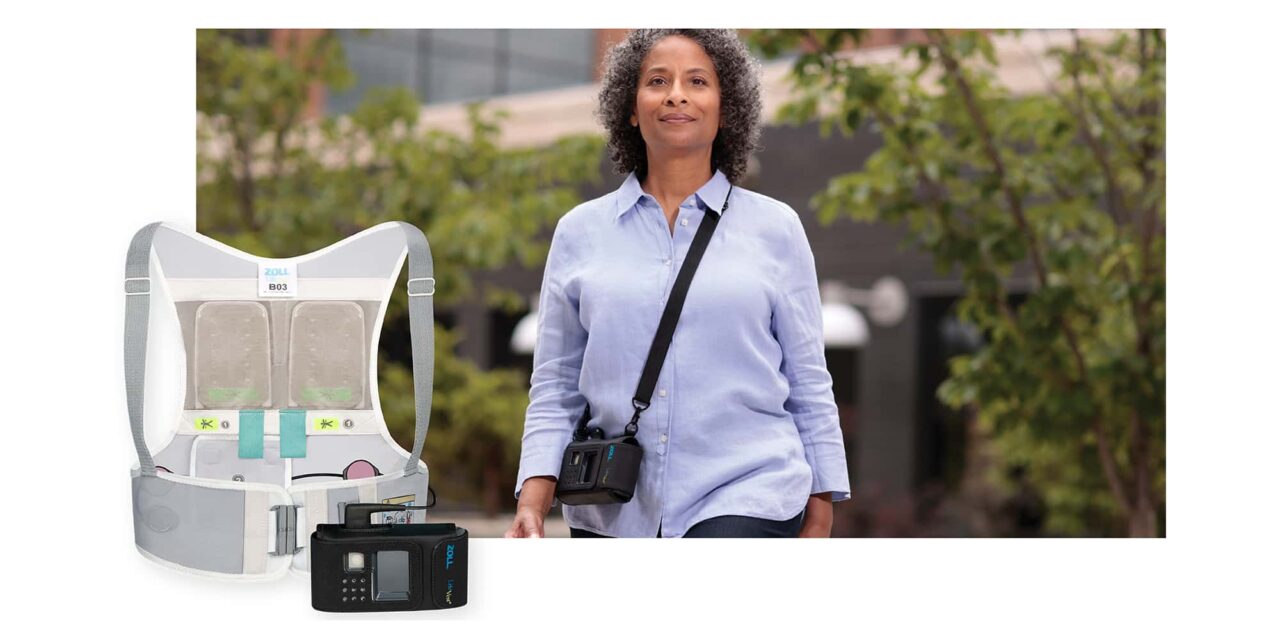
Zoll has completed the US rollout of its next generation garment for the LifeVest wearable cardioverter defibrillator (WCD), according to the company.
With continuous innovation and enhancements for patient comfort, this marks the third advancement of the LifeVest garment over the last five years, Zoll reports.
“The next generation LifeVest garment is a significant step forward in patient comfort and usability while maintaining market-leading clinical performance and safety,” said Peter A. Brady, MD, Vice President of Clinical Affairs for Zoll Cardiac Management Solutions. “We are committed to continuous innovation to help patients feel confident while staying protected. Now, we’ve made the LifeVest garment even more comfortable.”
The newest LifeVest garment builds upon progressive advancements over the last five years, with features designed to support patients in their daily lives outside of the hospital. Enhanced features include lightweight, athleisure-inspired performance-wear fabric, soft plush straps, flat-lock stitching, and the largest range of garment sizes, fitting chest measurements of 26-56 in.
- LifeVest ranks #1 in patient compliance at a consistent 23.4+ hours/day (median) based on peer-reviewed publications and real-world data, most recently validated in SCD-PROTECT (2025), a study of nearly 20,000 consecutive real-world patients.1,2,3
- In SCD-PROTECT, patients also experienced extremely low rates of inappropriate shocks (0.5% of patients) and discontinuation due to skin irritation (0.3% of patients).1
- The newest LifeVest garment represents a further advancement to this already impressive data. Patients prefer the next generation LifeVest garment as even more comfortable and easier to use.4
References from Zoll
1 David Duncker, Eloi Marijon, Marco Metra, Olivier Piot, Marat Fudim, Uwe Siebert, Norbert Frey, Lars Siegfried Maier, Johann Bauersachs, Sudden cardiac death in newly diagnosed non-ischaemic or ischaemic cardiomyopathy assessed with a wearable cardioverter-defibrillator: the German nationwide SCD-PROTECT study, European Heart Journal, 2025;, ehaf668, https://doi.org/10.1093/eurheartj/ehaf668
2 Garcia R, Combes N, Defaye P, et al. Wearable cardioverter-defibrillator in patients with a transient risk of sudden cardiac death: the WEARIT-France cohort study. EP Europace. 2020;23(1):73-81. doi:10.1093/europace/euaa268.
3 Data on file, 90d0258_a01. 2021 Commercial Compliance Analysis.
4 Data on file, 20c1184_a01. Garment Comparative Wear Test.
5 Based on commercial data as of November 2025.
6 Arkles J, Delaughter C, D’Souza B. A novel artificial intelligence based algorithm to reduce wearable cardioverter-defibrillator alarms. J Interv Cardiac Electrophysiol. 2023. https://doi.org/10.1007/s10840-023-01497-w.
7 Based on commercial data as of March 2025
Zoll disclaimer: A controlled, head-to-head study evaluating the comparative performance of available WCD devices has not been done.
Image credit: Zoll LifeVest WCD wearable cardioverter defibrillator via https://www.businesswire.com/news/home/20251202251747/en/The-Most-Comfortable-LifeVest-WCD-Ever-ZOLL-Completes-Full-U.S.-Launch-of-Next-Generation-Garment