
How a high-volume pediatric hospital implemented a collaborative protocol to improve pediatric asthma outcomes, eliminate variations in asthma management, and reduce emergency department visits.
By Karen Purfield MSN, RN, NEA-BC, CPN; and Jennifer Mahone MHA, RRT-NPS, AE-C
Asthma is one of the most common chronic diseases in children and is a leading cause of school absences, emergency department visits, and hospitalization.1 More than 4.5 million children live with asthma in the United States.1 Asthma affects more boys than girls in childhood and is more common in Black individuals, American Indian or Alaska Natives, and people of multiple ethnicities.1 It is associated with significant direct and indirect healthcare costs, with an estimation over $80 billion per year. For patients living with asthma in the United States in 2021, it is estimated 39.6% of adults and 38.8% of children had an asthma exacerbation in the past year.2
Confirming the diagnosis of asthma includes respiratory symptom history, physical examination, and pulmonary function testing to provide evidence of variable expiratory airflow. However, diagnosis for children five years of age or younger can be challenging as this is primarily a clinical diagnosis including: recurrent acute wheezing episode, no likely alternative cause for respiratory symptoms, and timely response to asthma treatment.3
Reading Hospital is the flagship hospital of the Tower Health System. Located in West Reading, PA, the 697-bed hospital is Magnet recognized and is an academic teaching facility with residencies in more than 23 clinical specialties; however, there is no pediatric intensive care unit. Annually, almost 500 pediatric asthma patients are discharged from the emergency department and over 200 are admitted for asthma care. The Children’s Health Center (CHC), an ambulatory pediatric practice on the hospital campus, is an American Academy of Pediatrics medical home. CHC has roughly 16,000 patient visits a year, with 10% seen specifically for asthma. These volumes of pediatric asthma patients drove the need for standardization of care.
Facility Overview
Executive leadership at the Reading Hospital wanted to strengthen the pediatric service line. In 2012, pediatric hospitalists were put in place. The hospitalists provided 24-hour-7 day a week coverage, allowing the inpatient unit to care for children who were more acutely ill. Upon being admitted to the hospital, patients are cared for in a 19-bed secured unit. Nursing care is provided by a dedicated staff, over 80% of whom are certified in pediatrics.
The hospital’s ED is one of the busiest in the country with over 116,000 visits per year. Many of those visits are by pediatric patients. In 2019, the organization opened a pediatric emergency department, led by a board-certified pediatric emergency medicine physician. The department features 16 exam rooms, including a resuscitation room, with skilled providers and nurses committed to pediatric and family centered care. It’s not only nursing and providers who are committed to the care of pediatric patients. Respiratory therapy expanded training and services for this specialized population. Pediatric topics are included in annual staff education and therapists attend pediatric mock codes annually as well. Respiratory therapists who are assigned to the ED do not have other patient assignments.
Establishing Need for RT/RN-Driven Protocol
An interdisciplinary team of community pediatricians, ED members, inpatient nursing, RTs, as well as pharmacy, was formed at Reading Hospital in 2012 because it was recognized there was variation in asthma treatment for patients in both the ED and inpatient areas. Treatment was not based on the severity of the patient but varied based upon individual provider assessment. Community pediatricians managed inpatients remotely from private practice because at this time there was not 24/7 in-house pediatric physician coverage. In the ED, pediatric patients were scattered throughout and not managed by physicians’ board certified in pediatrics.
The focus of the team was to create a pediatric asthma protocol for both areas of care. Prior to implementing the asthma protocol, the transfer rate to tertiary centers was 27%. Emergency department revisits within 7 days were 30% and 57% within 15 days. Goals of reducing variation of asthma management, improving clinical effectiveness, and reducing emergency department visits and transfers to tertiary centers were set.
The interdisciplinary team had three aims to the protocol:
- Development of a standardization of care via a clinical treatment pathway to decrease length of stay;
- Education to decrease readmissions; and
- Follow-up after discharge to decrease readmissions.
Standardization of Care
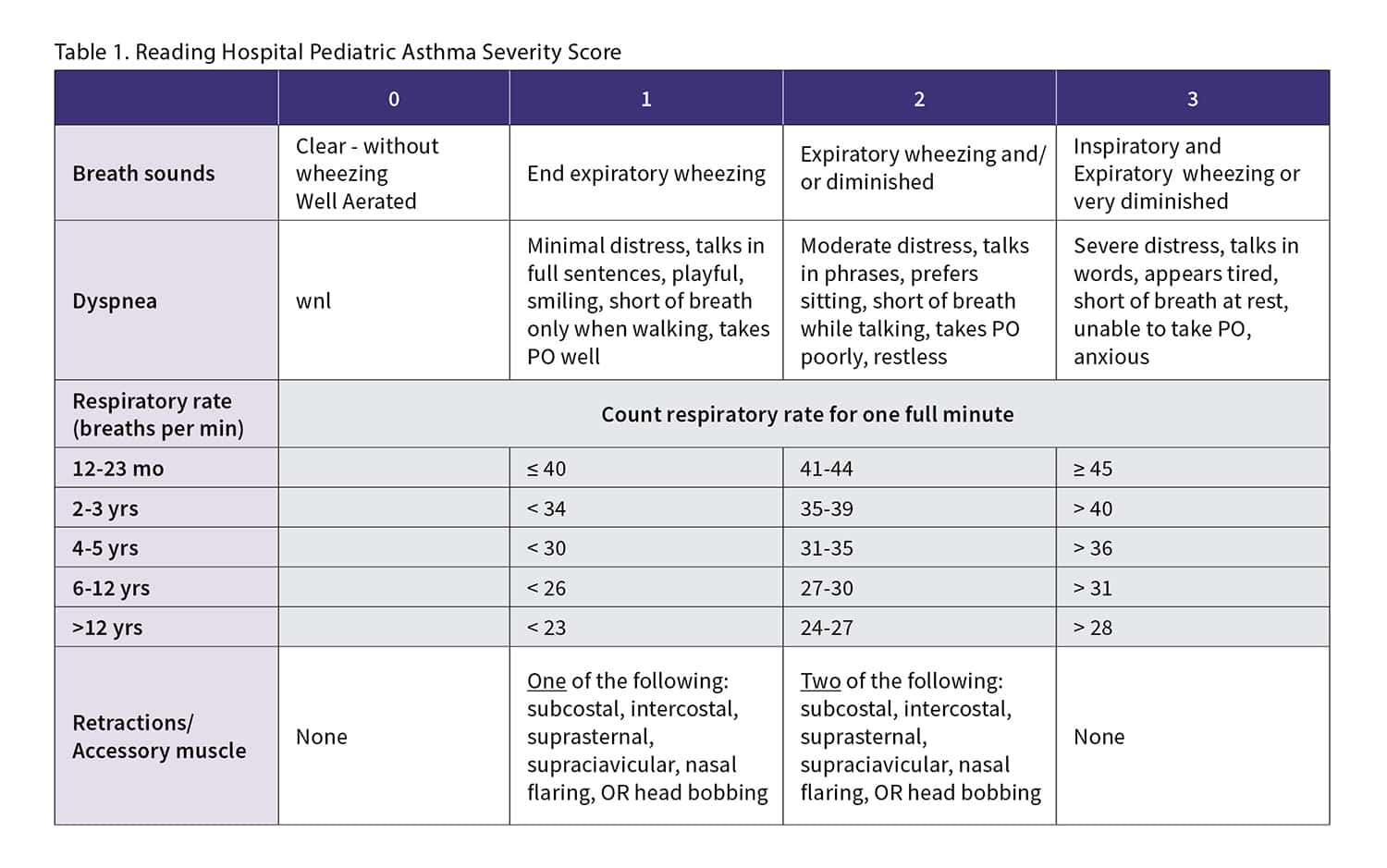
A key component of the protocol was standardization of care. A review of the literature was conducted to develop an evidence-based pediatric asthma severity score (PASS) that would be adaptable to the organization.
To establish the PASS, the RT and the registered nurse (RN) assess and score the patient at the same time to support interrater reliability. The severity level is discussed to ensure both agree upon treatment plan. If there is a difference in score, the provider is consulted to determine the severity level. This process is followed in both the emergency department and inpatient unit. RT and/or RN documents PASS in the EMR flowsheet.
During ED triage, the first PASS assessment is completed by the RN who can initiate the protocol to alert the RT that a patient requires evaluation. The RT completes a PASS assessment prior to initiating bronchodilator therapy as per protocol. The care team members communicate with the provider that the protocol has been initiated so they can order additional medications based upon severity. If the patient is admitted, the RT and RN score before every treatment. Once it is determined the patient is improving on the PASS, the RN is responsible for modifying orders to wean the bronchodilator therapy. When a patient’s score shows increased severity, the provider must be contacted to escalate care.
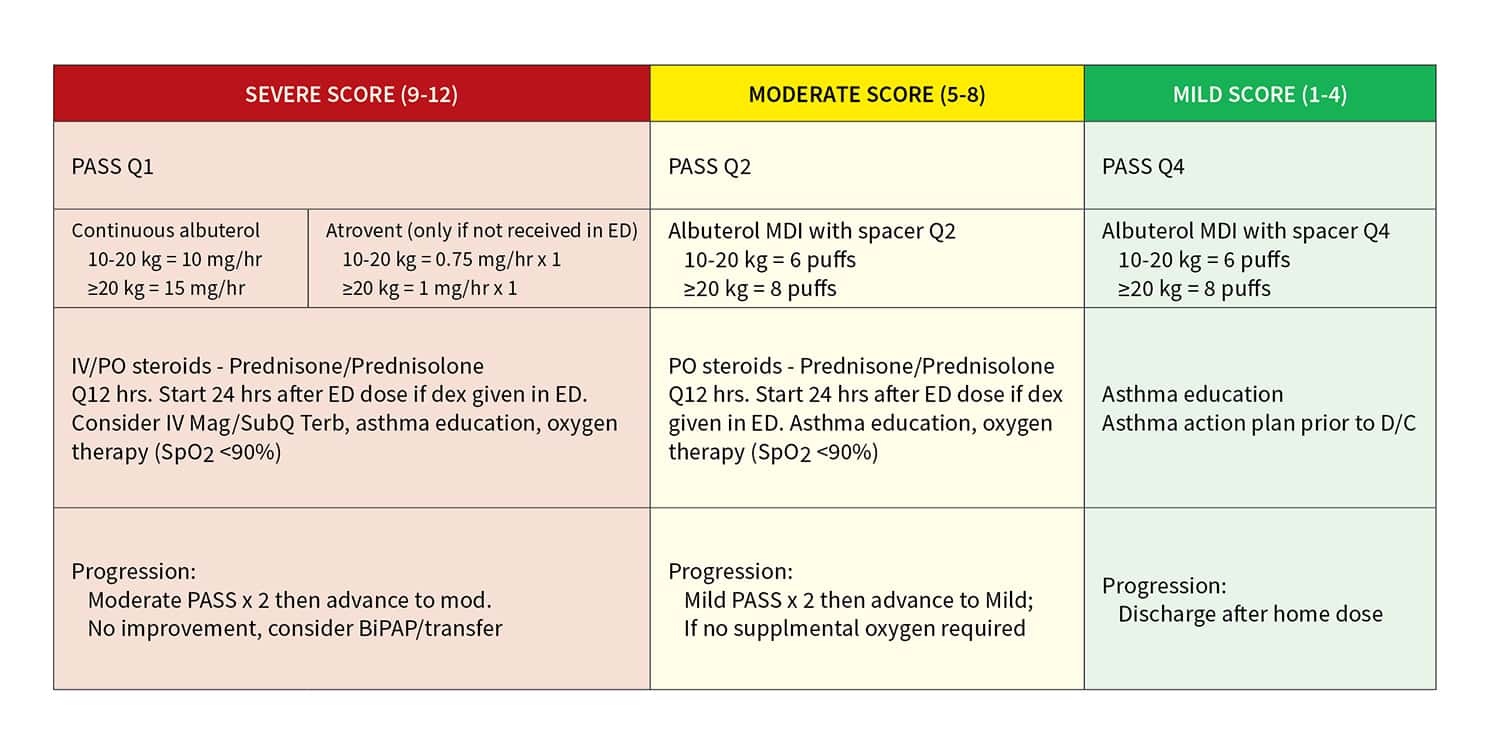
A treatment protocol was established to provide care based on the patient’s PASS score. Patients who are less acute receive less frequent treatment and assessments versus those who are more severe who receive more frequent interventions. Below is an example of progression through the inpatient protocol.
Education
To address the goal of decreasing readmissions, an education booklet was created including information on the disease process of asthma, triggers, treatment, and how to manage flares. Parents and/or caregivers were educated primarily by the RN throughout their hospitalization. Education was reinforced by providers and the RT on interdisciplinary rounds and at every patient encounter.
As the protocol evolved into more inhaler use and less aerosol use, the team created an inhaler instructional video. Education transitioned to videos on prevention and treatment of asthma available on bedside tablets. A QR code is available on their after-visit summary.
Prior to discharge, caregivers complete a perception of care survey located in the EMR. The results of this survey allow the care team to answer any additional questions the family may have before discharge and to ensure understanding of the education they have received.
Follow-up after Discharge
At the time of ED or inpatient discharge, patients are provided with an asthma action plan (AAP). The ED AAP is a basic management guide for asthma care and when to seek assistance from a provider. Inpatients receive an individualized AAP where modifications can be made to prevent future flares and hospitalizations. This AAP can be updated and reviewed by any provider within the health system who has access to the EMR. The plan is reviewed at least annually for patients of CHC.
In addition to reviewing the AAP with the patient, the hospitalist calls the primary care provider at the time of the patient’s discharge. Changes to asthma care management, including addition of maintenance medications, are shared in this verbal handoff of the hospital course. A follow-up appointment is scheduled during the call. Details of the appointment are listed on the discharge instructions.
Implementation and Process Improvement
Asthma metrics including door-to-PASS, door-to-albuterol, and door-to-steroid times as well as compliance with the patient perception of care survey and other asthma specific measures, such as readmission and transfer data, are shared at the Pediatric Quality Improvement Committee. This committee cascades information to the organization’s quality council and ultimately the hospital board of directors.
In the early stages of protocol implementation, chart audits were performed on all pediatric asthma patients to ensure staff compliance and understanding of the protocol. Counseling was provided to staff one-on-one and additional education was given if needed. Data was shared at the department level and feedback elicited from the interdisciplinary team on steps to improve the pathway.
When the program started the process for Joint Commission certification, the above metrics were changed to performance measures. These were tracked along with balancing measures of ED revisits, transfers, length of stay, and readmissions. The team continues to review these monthly to identify the areas that need improvement.
Results of Protocol Implementation
Initial goals, which remain an important focus today, are to identify patients quickly by completing the PASS score and treating them in less than 60 minutes of arrival, with bronchodilators and steroids if scoring moderate or severe. As mentioned before, this is a collaborative effort between respiratory therapy, nursing, and ED providers.
Over 93% of pediatric asthma patients received a PASS score within 30 minutes of arrival to the ED in 2025, and 89% of patients received steroids within 60 minutes of arrival. The median time to albuterol administration was 30.5 minutes, which is a 91% compliance rate.
Many improvements involved the EMR. One enhancement early on included making the PASS documentation more visible on the triage nursing screen. This led to improved identification of asthma patients to begin the pathway. Another enhancement included granting access to respiratory therapy and nursing to initiate the protocol on any pediatric asthma patient based on previous history, symptoms, and PASS. Respiratory therapy could order necessary bronchodilators based on scoring and algorithm. Timely albuterol administration was used as a performance metric on respiratory therapy annual evaluations.
With the creation of the pediatric emergency department, staff buy-in and adherence to the protocol significantly improved due to the focused care area. Despite the challenges presented by COVID, inhalers were implemented into the protocol in 2021. This improvement resulted in a significant win to increase patient and family compliance with medications. After reviewing the measures, additional EMR enhancements included adding communication in the ED order set to remind nursing to alert providers to place an order for steroids in moderate/severe patients. Additionally, a screening tool was implemented in ED triage. Based on the answers to the screening, a Best Practice Alert (BPA), triggers to prompt the triage nurse to score a PASS and initiate the protocol. The faster asthma patients can be identified, the quicker they can be treated.
Educating patients and families continues to be a significant focus of the asthma care. Asthma action plans are given in both the ED and inpatient care areas. By adding the AAP to the order sets, staff were reminded to review this, resulting in an increase in the number of patients receiving an AAP at discharge. A review date was added so both inpatient and outpatient providers know when it was last reviewed or needs reviewing. The success of education can be seen with ED revisit and readmission data. Emergency department revisits within 72 hours were 2.6% in 2024 and 30-day readmissions were less than 2%.
Conclusion
By standardizing treatment of the pediatric patient with asthma throughout the continuum of care, the patient receives the best outcome. Evidence based protocols are followed from the time of entry into the hospital through discharge and community follow-up. The care team ensures there is an understanding of asthma treatment at home to prevent revisits to the ED and readmissions.
Throughout the years of implementing, reviewing, and enhancing the asthma protocol, the team has focused on many core and balancing measures to guide the areas of focus for improvement. Through this focus of process improvement, the program has become one of the few in the country certified by The Joint Commission. The program first obtained certification for pediatric asthma in 2019 and has received three recertifications most recently in February 2026. The goal is not to be perfect, but to continue to safely, effectively, and efficiently keep patients in the community through evidence-based care. This is achieved with a strong institutional commitment, an interprofessional team approach, and collaboration with ambulatory partners, always keeping the patient and their family as the center focus.
RT
Karen Purfield, MSN, RN, NEA-BC, CPN, is currently the nursing unit director of pediatrics at Reading Hospital – Tower Health.
Jennifer Mahone MHA, RRT-NPS, AE-C, is currently the system director of respiratory care at Reading Hospital – Tower Health.
For more information, contact [email protected].
References
- Centers for Disease Control and Prevention. Most Recent National Asthma Data, 2021. Updates May 2023. Most Recent National Asthma Data | CDC.
- Patel, K.B., Mims, J.W., Clinger, J.D. The burden of asthma and allergic rhinitis: epidemiology and health care costs. Otolaryngologic Clinics of North America. 2024;57(2):179-89.
- Global Initiative for Asthma. Global Strategy for Asthma Management and Prevention, 2024. Updated May 2024. https://ginasthma.org/2024-report/