
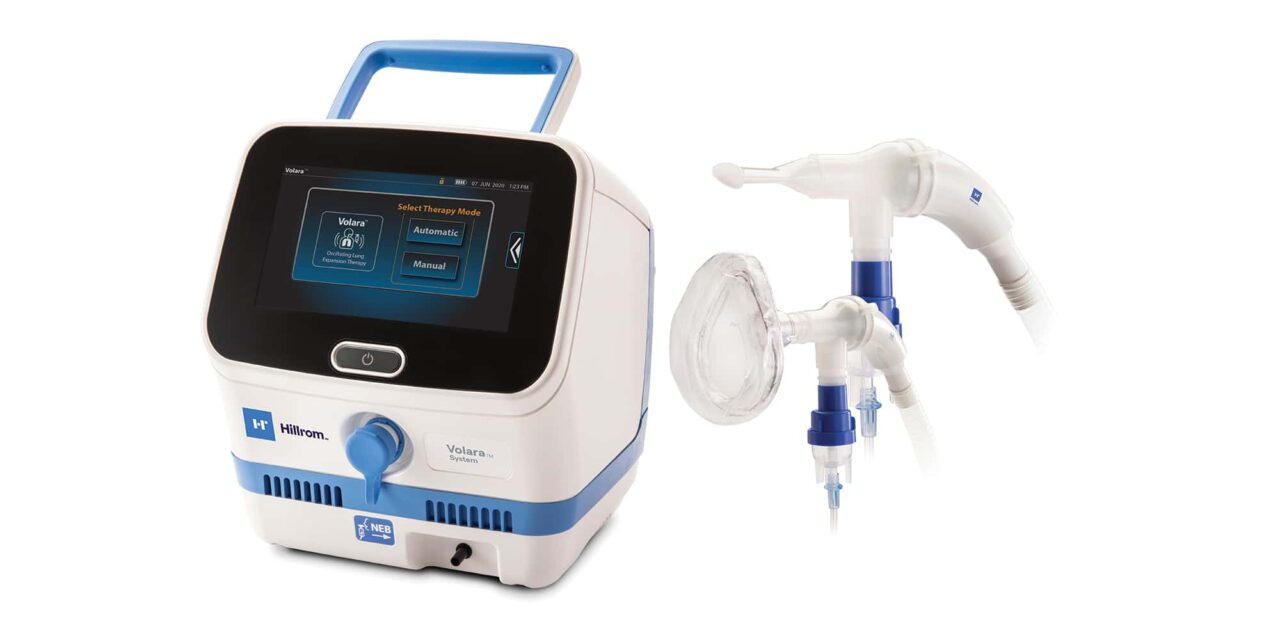
The Volara Airway Clearance System combines oscillation and lung expansion therapy with aerosol delivery to improve clinical outcomes and reduce pulmonary complications.
RT’s Three Key Takeaways:
- Integrated Therapy Approach: The system combines continuous positive expiratory pressure, continuous high frequency oscillation, and nebulizer delivery to expand lungs and mobilize secretions.
- Clinical Outcome Data: A multicenter study of 419 high-risk surgical patients showed that the therapy reduced the rate of postoperative pulmonary complications when added to standard care.
- Versatile Patient Interface: The device supports multiple delivery modes, including tracheostomy, mask, and in-line ventilator use, for patients aged 2 years and older.
Baxter is offering the Volara System to deliver oscillation and lung expansion (OLE) therapy for patients in both acute care and home settings, according to product information from the company. The system is designed to provide airway clearance by combining three therapies into a single 10-minute session.
The technology utilizes alternating cycles of continuous positive expiratory pressure (CPEP) and continuous high frequency oscillation (CHFO). CPEP therapy helps treat and prevent pulmonary atelectasis by combining continuous positive pressure with aerosol medication to expand and hold airways open. CHFO, a pneumatic form of chest therapy, delivers continuous pulses of positive pressure to mobilize retained secretions.
An integrated nebulizer delivers aerosol medication during both the CPEP and CHFO cycles to help loosen secretions and enhance therapy efficiency.
According to clinical data provided by the company, OLE therapy has demonstrated positive clinical outcomes and potential economic savings in acute care environments. A two-phase multicenter study of 419 patients showed that pulmonary treatment with OLE therapy, used alongside standard respiratory therapy, reduced the rate of certain postoperative pulmonary complications in high-risk surgical patients. These results were specifically noted in patients who underwent thoracic, upper abdominal, or aortic open surgical procedures.
The system features a digital touchscreen interface that allows healthcare providers to program and name up to 10 custom physician-prescribed presets for standardization across different patient groups. The device also includes a standard HL7 interface to send therapy data to electronic health records (EHR).
Designed for versatility, the system accommodates multiple delivery modes, including mouthpiece, facemask, tracheostomy, and in-line use with a ventilator. It is indicated for use in patients aged 2 years and older.
The portable unit includes a dual power source with battery operation and a built-in compressor, allowing for use in various hospital settings. For patients transitioning out of the hospital, the system can be used in the home setting while maintaining the same physician-prescribed protocols and settings used during acute care.
The Volara System also incorporates smart-filter technology with an integrated radio frequency identification (RFID) tag. This feature tracks the single-patient-use circuit, which is designed to deliver a maximum of 90 therapy sessions, according to Baxter.
Source
- https://respiratory-therapy.com/products-treatment/monitoring-treatment/therapy-devices/products-2025-secretion-clearance-suction/
- https://www.hillrom.com/en/products/volara-acute-care






Could you tell me if the colors system also does a cough assist with it?